
Manage configuration intent across its full lifecycle.
Model multi-vendor CLI and API intended configuration state with declarative enforcement.

WHY IT MATTERS
Configuration intent needs a lifecycle, not a collection of one-off changes.
A successful command does not by itself establish that the network meets the intended policy. Teams need to define required state, understand the current configuration, control policy revisions, and apply the changes needed to reach the approved state. Config Model Editor provides those configuration intent management constructs within the Gluware platform.
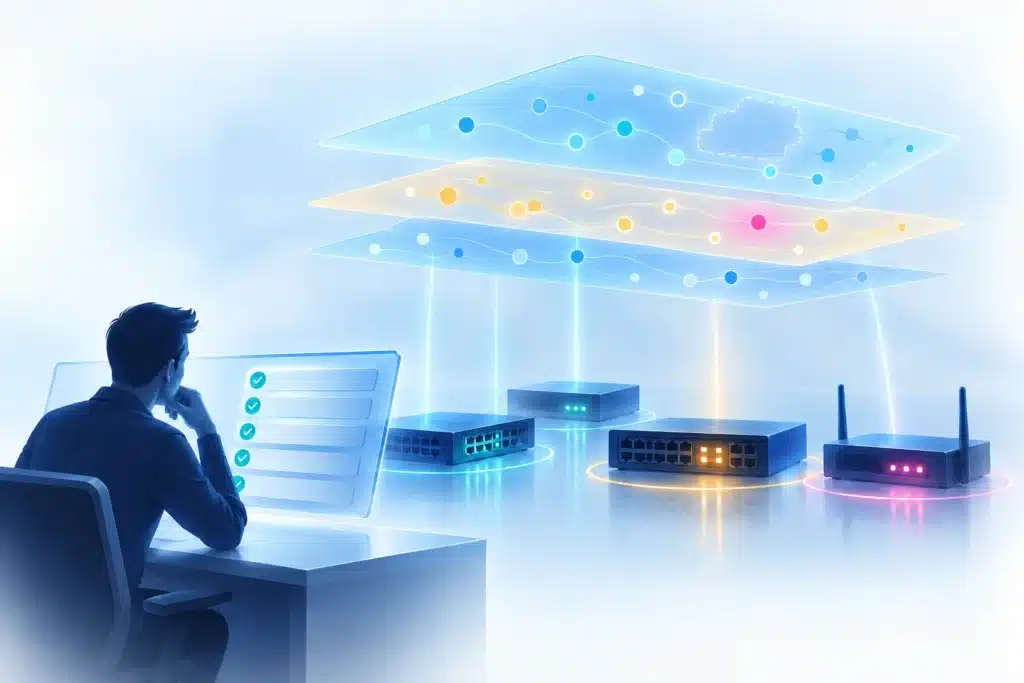
WHAT CONFIG MODEL EDITOR PROVIDES
Capabilities built for the work.
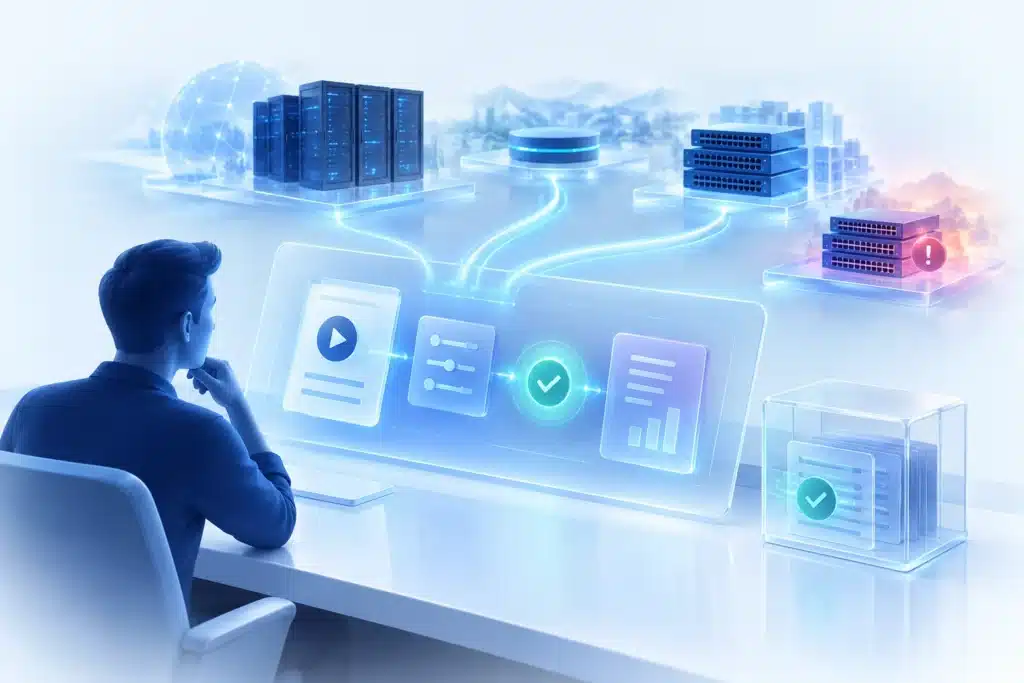
THE BUSINESS CONTRIBUTION
Connect the capability to visible value.
Configuration intent management turns enterprise standards into reusable automation. It gives teams a way to extend approved policy across the fleet while investing their expertise in required behavior, exceptions, and verified results.
PART OF THE FULL STACK
Connect the work to the wider platform.
Device Manager provides discovered devices; CME owns multi-vendor CLI/API configuration intent models, previews, declarative provisioning, and CLI/API state assessments. Config Drift & Audit owns snapshot comparisons and audit policies. Network RPA coordinates the distinct operations; Git integration synchronizes CME constructs for backup and restore.
Foundations
DIAL
The Device Interaction and Automation Layer handles multi-vendor device interaction, semantic translation, normalization, and deterministic validation through CLI and API interfaces.
Business outcome solutions
Config Drift & Audit
Capture actual configuration and operational state, compare it with baselines, and audit the controls required by your enterprise.
Orchestration & integrations
Network RPA
Build and run visual processes that connect Gluware applications, external systems, operational logic, scheduling, and traceable tasks.
Put Config Model Editor to work.
See how this capability can support your next network automation outcome.
PLATFORM CAPABILITIES
CAPABILITIES THIS COMPONENT SUPPORTS
See the functional value.
Network discovery & onboarding
Discover the fleet, establish device context, and turn existing configurations into models your team can manage.
Device & OS lifecycle management
Connect discovered inventory, device advisories, image selection, deployment plans, and operational checks.
Configuration intent & drift management
Define reusable configuration intent, detect departures, apply modeled changes, and reassess the result.
Continuous compliance & reporting
Connect repeatable policy checks, corrective processes, and evidence that operations, security, and compliance teams can review.
Network exposure management
Bring device advisories, contextual CVE assessment, and supported remediation into a governed network process.
Cross-system orchestration
Connect network tasks, source-of-truth data, service-management steps, external executors, and records in a repeatable process.
AI-assisted automation building
Combine conversational assistance, development tools, and supported agent services with the applications that operate the network.
Network state assessments
Define CLI/API state checks for on-demand assessment, provisioning pre/post checks, and Network RPA tasks.
NIST & Cisco CVE/PSIRT integrations
Associate Cisco PSIRT advisories and NIST/NVD CVE information with discovered devices and software.
Configuration audit
Evaluate required and forbidden configuration conditions with repeatable audit policies and evidence.
Git integration
Synchronize supported constructs, audit policies, and Network RPA artifacts with Git-based repositories.
OS management & patching
Plan, validate, schedule, and review supported network software upgrades, downgrades, and patching operations.
Backup & restore
Back up supported device configurations and preserve the model, policy, and process artifacts needed to operate them.