By Ernest Lefner, Chief Product Officer, Gluware
Nearly every networking vendor is introducing a trust framework to reassure enterprises on their journey towards agentic NetOps. That’s a good thing, and there’s no doubt that this is needed, yet customers routinely tell us that they believe there is still much work to do to mature agentic NetOps to the point that it is truly safe for autonomous action.
Most agentic trust architectures we’ve seen thus far emphasize governance, policy controls, and agentic reasoning. These are essential capabilities, but they answer different questions than whether an AI-generated output is actually correct. Governance and policy controls tell you an agent’s actions were reviewed, not that they were right. And while agentic reasoning is powerful, without independent validation, it’s probabilistic and prone to unpredictable outcomes. There is a critical burden of proof for agentic accuracy, especially in complex, multi-vendor and mission-critical enterprise network environments. Proof of accuracy has remained as a critical gap in agentic trust. That gap needs to be closed.
That’s why with the GA of Titan AI we are releasing what we believe is the industry’s first agentic trust framework for NetOps that is built not just to govern agentic actions, but to establish proof that multi-vendor, multi-domain agentic NetOps actions are worthy of trust.
Agentic trust needs more than governance
AI and agentic workflows hold huge potential for accelerating network automation. However, the value of agentic productivity is significantly offset by its inherent probabilistic nature. By itself, it cannot predictably produce reliable, accurate outcomes. It requires more than guardrails. In a sense, this is not news, and multiple vendors in the networking space have announced agentic frameworks that purport to solve the problem. Yet in most cases, the answer is limited to a governance framework that creates a controlled process by which an organization can check agentically reasoned recommendations before taking action.
There is nothing bad to say about governance. It is necessary for sound agentic supervision. Governance by itself may be sufficient for low-stakes network operations actions such as analyzing observability data. However, when it comes to making actual changes in a complex, multi-vendor network that have any scope of impact, a completely different level of trust must be established: proof that agentic recommendations and actions will result in predictably accurate outcomes.
In most cases that we’ve observed, the actual checking is left open for customers to solve themselves. That is a heavy burden, one that creates a significant barrier to progressing agentic NetOps.
As a full stack network automation platform built around intrinsic governance as well as deep semantic validation, we saw an opportunity to advance the state of the art in agentic trust for NetOps.
The Gluware Proof of Agentic Trust Framework
Gluware has established an architectural framework that guides all its agentic operations, and which establishes not just a sound process or governance model, but also sufficient proof, based on deterministic evidence, that organizations can trust agents to take high-impact actions such as generating artifacts to deploy in automation or directly implementing network OS updates and configuration changes to remediate drift, bugs, and security vulnerabilities.
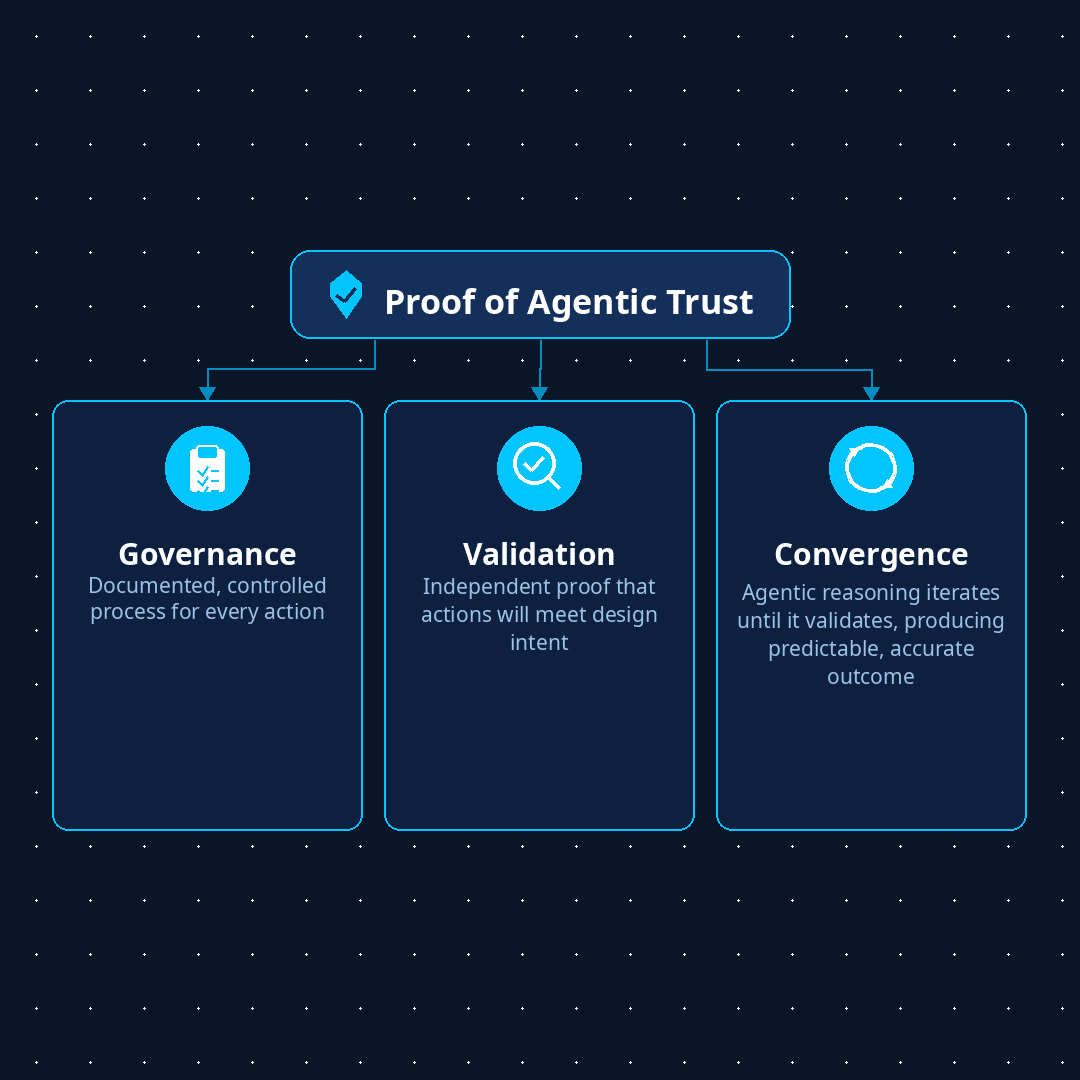
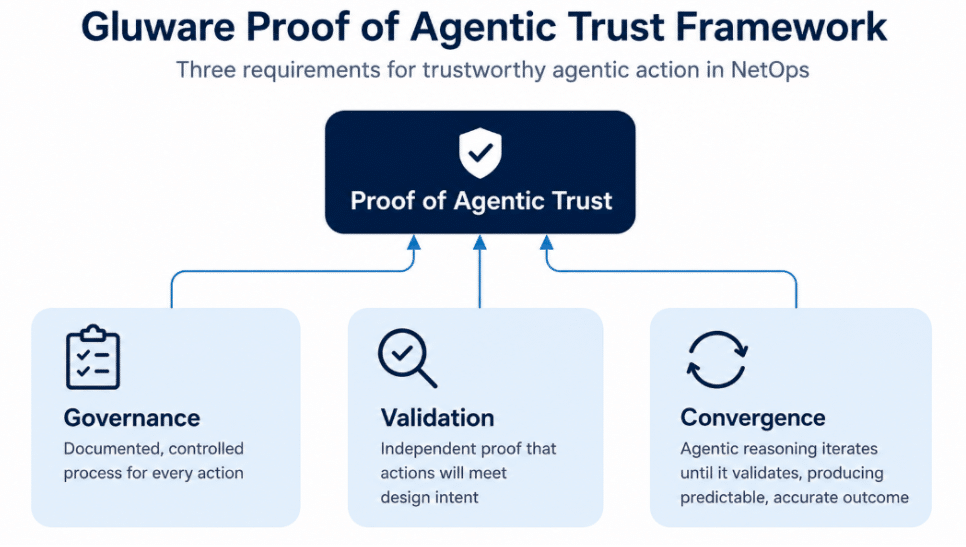
The framework is founded on three core requirements that must all be met to establish trust in agentic reasoning:
- Governance: An understandable and documented, controlled process from agentic reasoning to execution. In Gluware’s case, governance is achieved via a rules-based order that implements constraints and controls within the Gluware application.
- Validation: A proven, deterministic validation capability, architecturally independent from the agentic reasoning process, that verifies proposed actions faithfully implement the intended design. In Gluware, validation is deterministic because it is tied to the known, rules-based order within the application.
- Convergence: Goal-oriented agentic reasoning that iteratively proposes and refines solutions until they satisfy independent validation. In Gluware’s case, since validation is tied to a known set of rules, convergence produces repeatable, predictable results.
These three pillars answer fundamentally different questions. Agentic reasoning determines what the AI believes should be done. Validation determines whether the proposed action faithfully implements the intended network design. Governance determines whether that validated action should be authorized and executed. Conflating these distinct architectural functions under the single label of “trust” obscures an important difference between supervising AI and proving the correctness of its output.
The distinguishing element of the framework is independent validation. Agents, being probabilistic in their proposed actions, cannot be trusted to validate themselves. And iterative, goal-driven reasoning — the kind that powers convergence — is a real, native capability of agentic AI, but without an independent source to check against, that iteration has nothing to converge toward; it is limited to repeated probabilistic refinement rather than deterministic verification.
Agents must be able to leverage an independent source of intent validation that is proven to produce accurate results. When sound, independent validation exists, agents can follow a governed process that leverages a goal-oriented agentic reasoning path (such as graph-based agentic workflows) to build proposals, test them with the validation capability, and iterate until validation fully passes muster, at which point the agentic process can confidently deliver a reliable, predictable, accurate outcome.
How Titan AI Implements Proof of Agentic Trust
The architecture of Titan AI, built within the governed constraints of the Gluware Platform, delivers on the Proof of Agentic Trust Framework. To begin with, instead of relying just on LLMs, we built an MCP server with a set of skills that are trained and capable of specific tasks. The builder tools are paired with validation skills. That build/validation loop is executed by our agentic AI using graph-based reasoning until it provides a validated, accurate output.
This is a key component of producing reliable and predictable use cases for Titan AI within Gluware. Furthermore, Titan AI-generated artifacts are used within the Gluware application framework that provides additional compliance and controls.
The initial GA of Titan AI is Gluware’s first demonstration of this architectural framework, addressing a relatively safe yet high-impact use case: scaling up automation building to overcome the adoption barrier.
Solving the Network Automation Adoption Problem, Agentically
There is broad consensus that it is early days for autonomous agentic action in changing network configurations, and that the biggest current barrier to network automation success is simply driving adoption. Gartner observes that most enterprise network automation stalls out at about 25% adoption after SD-WAN controllers and limited implementations of open source tools hit their ceiling. Network Automation Platforms (NAPs in Gartner parlance) like Gluware help by reducing the integration work needed to accomplish automation. But still the biggest challenge is the ability of an already-busy network engineering team to devote the time and develop the ready fluency needed to build automation consistently enough to keep up with change and to grow adoption. This challenge is amply covered in our blog on how “<a ” href=”https://gluware.com/ai-should-bend-the-branch-lower-for-network-automation/”>AI Should Bend the Branch Lower for Network Automation.”
Titan AI’s first GA release is devoted to solving this problem. Our approach to introducing AI into the platform is to provide value added capabilities without introducing risk.
The GA of Titan AI takes the previously released Gluware Co-Pilot beyond RAG-informed answers to platform and documentation questions. Titan AI pairs the Co-Pilot with an Agentic Framework and a MCP Server with built-in tools to accelerate building automation at an expert level.
Need to build a network state assessment using vendor show commands? Co-Pilot generates it. Need a LiquidJS template to format workflow output? Co-Pilot writes it.
In other words, the initial Titan GA is purpose-built to provide a trusted agentic assistant that helps teams reliably build, maintain, and grow network automation adoption on the Gluware NAP. It also acts as the first implementation of Gluware’s Agentic Trust Framework, in a form that many Gluware customers are ready and eager to try now.
How We Applied our Agentic Trust Framework to Titan AI
Titan AI is built around our three stage architectural framework for agentic trust:
- Governance: The Gluware Co-Pilot interacts with our MCP server that implements a governance model built into the Gluware application, including enterprise controls such as RBAC and audit trails, as well as scoping to constrain answering NLP questions to the bounds of Retrieval Augmented Generation (RAG) inputs and pre-built agentic skills.
- Validation: The MCP server implements pairs of skills for building and validating:
- Configuration Modeling data models
- Network state assessments
- Dynamic compliance audits<
- Report generation
- Automation building blocks including:
- Network RPA tasks
- Liquid.js templates
- Regex expressions
- Output parsers
- Validation logic
- Forms and UI elements
- Business logic within the Gluware IDE<
- Convergence: Titan AI uses graph-based reasoning to perform iterative building and validation until it arrives at a high-confidence, reliably accurate outcome to the request.
This is only the beginning
In May, we announced and then demonstrated a groundbreaking new technology built on our Agentic Trust Framework: Titan Exposure Management, which won the Best in Show at the AI Networking Summit for Agentic AI. This new agentic capability can assess the relevance of masses of CVEs against the actual configuration and operational state of the network, then recommend and implement patches or compensating controls.
The centerpiece of this and every other forthcoming agentic capability is Gluware DIAL (Device Interaction and Automation Layer), a core component of the Gluware NAP and the industry’s only field-proven, multi-vendor and cross-domain intent discovery and semantic validation engine. DIAL offers the only packaged solution to perform independent validation of 56+ OSes across 22 vendors, interfacing with both devices and vendor controllers across any and every network domain (data center, campus, WAN, etc), operating within a controlled governance model and powering agentic reasoning to trustworthy agentic action outcomes.
Multi-vendor, cross-domain validation is important because most networks are multi-vendor, and they don’t function as islands of vendor-specific equipment, but as an integrated, algorithmically-driven system delivering packets end-to-end. If you can’t provably validate across your whole network, you don’t have real validation.
With Titan Exposure Management on its way to early field trials (EFT), Gluware Proof of Agentic Trust will become an operational reality for high-impact, autonomous agentic network changes. Over time, we’ll continue to add builder and validation skills to our MCP server.
In the meanwhile, if you’re ready to leverage Titan AI to build agentically in a trusted fashion, request a demo and start your Gluware automation journey.