By Ernest Lefner, Chief Product Officer, Gluware
Vibe coding has become shorthand for using AI to generate software from natural language prompts. The model produces code, the developer reviews it, makes a few adjustments, and iterates until it works. For many software projects, this is an effective way to accelerate development because defects can usually be corrected with another build, another deployment, or a rollback.
Network operations has always operated under a different engineering standard. Every production change is expected to produce a known operational outcome before it is executed. The question is never whether a configuration looks reasonable or whether an AI generated something plausible. The question is whether the network will behave exactly as intended after the change.
Independent Validation is the Standard
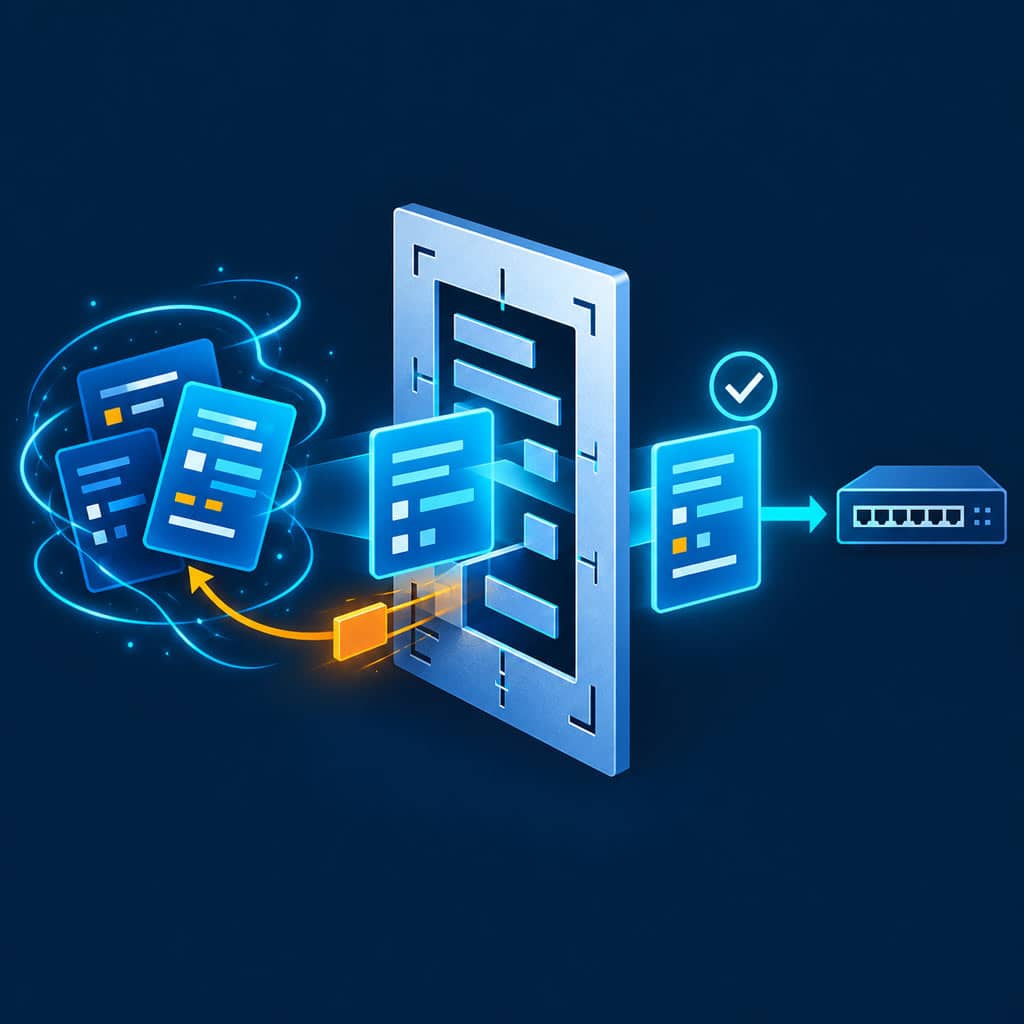
In our recent Proof of Agentic Trust Framework blog, we argued that trustworthy agentic automation depends on three operational requirements. Every action must follow a governed operational process. Every proposed change must be validated independently against the intended operational outcome. Execution must converge predictably to that outcome before production is touched. Those are not AI requirements. They are operational requirements that have governed production infrastructure for decades.
That framework also explains what I mean by “vibe validate.” I am not suggesting AI cannot help validate a proposed change. It can. Gluware Titan is built around exactly that concept. By “vibe validate,” I mean accepting a production change because an AI generated it, explained it, or expressed confidence in it. Production infrastructure has never operated on confidence. It operates on evidence.
Large language models are remarkably good at producing configurations, policies, and automation workflows. They reduce the effort required to author a change, but they do not establish what that change will do once it reaches production. Operations teams still have to answer the same questions they answered before AI existed. Will traffic continue to follow the intended paths? Will segmentation remain intact? Will redundancy survive a device or link failure? Will routing converge correctly? Will every affected system reach the intended operational state?
Those questions cannot be answered by inspecting the generated configuration. They require independent validation of the operational outcome. A proposed change is only a hypothesis until there is objective evidence that the network will converge to the intended operational state after execution.
That standard has existed for decades. Engineers review one another’s changes because authorship is not proof. Changes are tested because intended behavior and actual behavior are not always the same. Maintenance windows exist because the consequences of failure are measured in outages, security exposure, and business disruption. AI changes who produces the first draft of a configuration. It does not change the burden of proof required before that configuration reaches production.
The current excitement around vibe coding reinforces that point. AI can generate a proposed infrastructure change. AI can participate in validating that proposed change. Neither is sufficient on its own. The operational requirement is independent evidence that the network will converge to the intended operational state before execution. That is the standard production infrastructure has always required, regardless of whether the first draft was written by an engineer or an AI.
Organizations that adopt agentic automation successfully will not be the ones that generate the most changes. They will be the ones that can prove, consistently and independently, what those changes will do before they are allowed to touch production.
You can vibe code. You can’t vibe validate.
Production infrastructure has never accepted changes because someone believed they would work. It accepts changes because there is objective evidence that they will work. AI has changed how infrastructure changes are created. It has not changed the operational standard for approving them.
Learn More
To learn more about the operational principles behind trustworthy agentic automation, read our Proof of Agentic Trust Framework blog.
To see those principles applied in practice, watch our Titan AI demonstration. It shows how Titan generates automation artifacts while independently validating proposed changes before execution, bringing AI-assisted generation and operational proof together in a governed workflow. Gluware’s DIAL technology validates AI-generated actions against real device behavior and vendor semantics rather than relying on the model’s confidence alone.
Get Started
If you’re evaluating how to safely introduce AI into network operations, request a demo to see how Gluware combines AI-assisted generation, independent validation, governed execution, and predictable convergence to deliver Proof of Agentic Trust before production changes are executed.