By Alex Henthorn-Iwane, Senior Vice President of Marketing, Gluware
From building automation to analyzing exposure and taking validated action, Gluware gives customers a practical path to agentic network operations.
Companies want agents doing real work on their networks. They also know what a bad network change can cost. Before they hand over control, they need confidence that the work is right, that it follows their operating rules, and that they can verify the outcome.
Gluware’s Agentic Framework is built to earn that trust in stages. In July, agents started with the safest job: helping engineers build automation. Today, they move onto the live network, assessing real exposure without changing anything and fixing what they find when customers are ready. And for the first time, customers can build agents of their own. Every step rests on the same foundation, Proof of Agentic Trust, so the confidence earned at one step carries into the next.
At the ONUG AI Networking Summit Fall 2026 in New York City, October 28–29, customers will have a chance to see a demo of what this looks like in action.
The foundation is Proof of Agentic Trust
When we introduced Proof of Agentic Trust with Titan AI’s July general availability, we defined an architecture that guides every step we take: governance establishes whether an action is permitted, and technical validation establishes whether the proposed action faithfully implements the intended network design. Agents need both.
Our framework adds a third piece, convergence, that connects them. Agents propose solutions, platform capabilities check those proposals independently of the agent’s reasoning, and agents refine their work in response to validation feedback. Approved actions then proceed through controlled execution workflows.
DIAL, Gluware’s Device Interaction and Automation Layer, is central to why we can do this. It understands what device configurations mean across a multi-vendor network, so it can check whether a proposed change actually does what was intended. Together with Gluware’s modeling, OS and configuration management, and state assessment capabilities, it supplies the technical foundation for independent validation.
That foundation represents a dozen years and more than a million engineering hours. An agent connected to device commands, even with an approval process, does not gain those capabilities simply by being connected. Gluware brings a validation and execution platform already trusted to run some of the world’s largest and most complex enterprise networks, so customers build on a foundation proven where the stakes are highest.
Step one: Empower engineers building automation
Titan AI’s July GA began with a comparatively safe, useful job: helping engineers create the automation they need. The initial role was to build artifacts for use within Gluware’s governed platform.
Through paired MCP builder and validation skills, agents can generate configuration modeling data models and forms, Network RPA orchestration tasks, network state assessments, dynamic compliance audits, and reports. Supporting elements include parsers, templates, regular expressions, validation logic, and IDE business logic.
This addresses a practical adoption barrier. Busy engineers need time to turn operational requirements into automation. Agentic building reduces that effort, while independent validation gives the agent a basis for improving its output.
Introducing Titan Exposure Analysis and Exposure Remediation
Step two: Understand exposure without changing the network
In May, we demonstrated Titan Exposure Management at ONUG’s AI Networking Summit, where it won Best in Show for Agentic AI. We are now making that capability easier to adopt through two distinct offerings: Titan Exposure Analysis and Titan Exposure Remediation. This enables customers to begin with read-only intelligence and advance to automated corrective action when ready.
Titan Exposure Analysis applies agentic intelligence to the actual network without making changes. An affected OS version does not tell the whole story. Exposure can depend on device configuration and whether a vulnerable feature, protocol, or service is present and active. Titan examines OS version, configuration, and operational feature state to assess relevance and provide verdicts, evidence, and recommended actions.
Customers can review the findings against their own infrastructure, see how that intelligence works, understand its conclusions, and feed that intelligence into their existing tools and processes without granting Gluware automated write capabilities.
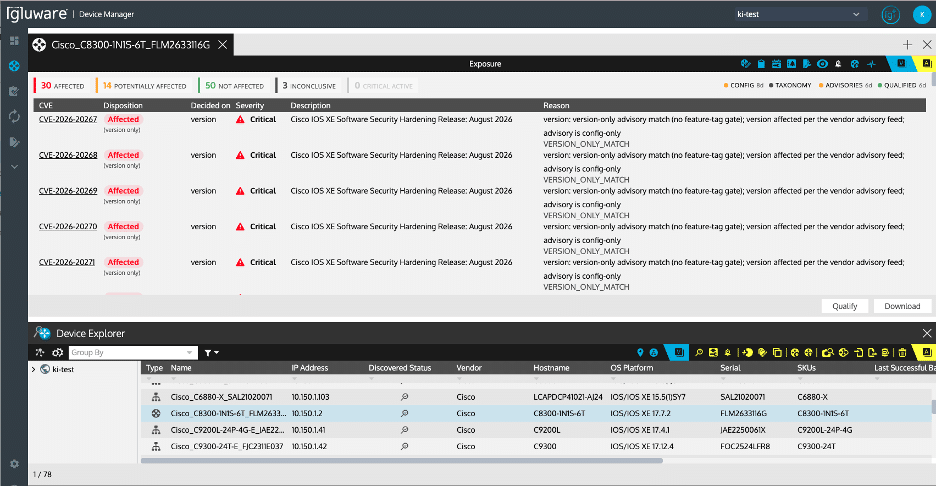
The way that Titan Exposure Analysis shows up can be seen in the above Device Manager view, which distinguishes affected, potentially affected, not affected, and inconclusive findings. It shows severity, the basis and reason for individual verdicts, and the freshness of underlying data. Teams can inspect how a determination was reached, including where it rests on an OS-version match.
Step three: Fix exposures under operational control
When a customer is ready to move from analysis to action, the Titan Exposure Remediation adds the automated write capabilities of Titan Exposure Management. It enables agentically initiated configuration changes, compensating controls, and OS upgrades through validated and governed capabilities within the Gluware platform.
This means customers give the agent more authority without giving up control. Every fix it proposes runs through Network RPA, which coordinates approvals, technical checks, execution, and verification of the outcome. DIAL independently validates that each change does what it’s meant to, so a fix is both approved and verified as correct before it reaches the network.
The two modules make that decision explicit within Titan Exposure Management. Begin with analysis, assess the evidence, and opt into remediation when the organization is ready.
Now it is your turn to build agents
The Agentic Framework also gives customers an agentic studio capability on this same foundation. Administrators create purpose-specific agents with custom instructions, selected LLMs, and assigned MCP server connections. With the appropriate tools, those agents can build Gluware automation elements and initiate orchestrated workflows.
One rule holds across every use case: agents can propose what should happen, but the Gluware platform controls how it happens. Every change to the network runs through a proven, validated process, never an agent’s best guess. That’s what lets customers move faster with agents without giving up predictable results.
Each new capability is another step on the same path
Future capabilities will extend this progression. As Gluware adds agentic skills and use cases, Proof of Agentic Trust remains the foundation: independent technical validation, governed execution, and evidence customers can assess. Each release will expand what agents do while ensuring customers retain control over how far and how quickly they proceed.
Join Gluware at the ONUG AI Networking Summit Fall 2026 in New York City on October 28–29 to see the Agentic Framework in action. Contact Gluware to explore customer-created agents or begin with Titan Exposure Analysis and progress to remediation when ready.