By Alex Henthorn-Iwane, Senior Vice President of Marketing, Gluware
For years, network patching has lived in the background. Security teams published advisories. Infrastructure teams scheduled maintenance windows. Some organizations stayed reasonably current. Many did not. Most accepted a certain amount of risk because the volume of patches was manageable and the operational cost of deploying them across large brownfield networks was enormous.
That era is officially coming to a close. Thanks, AI.
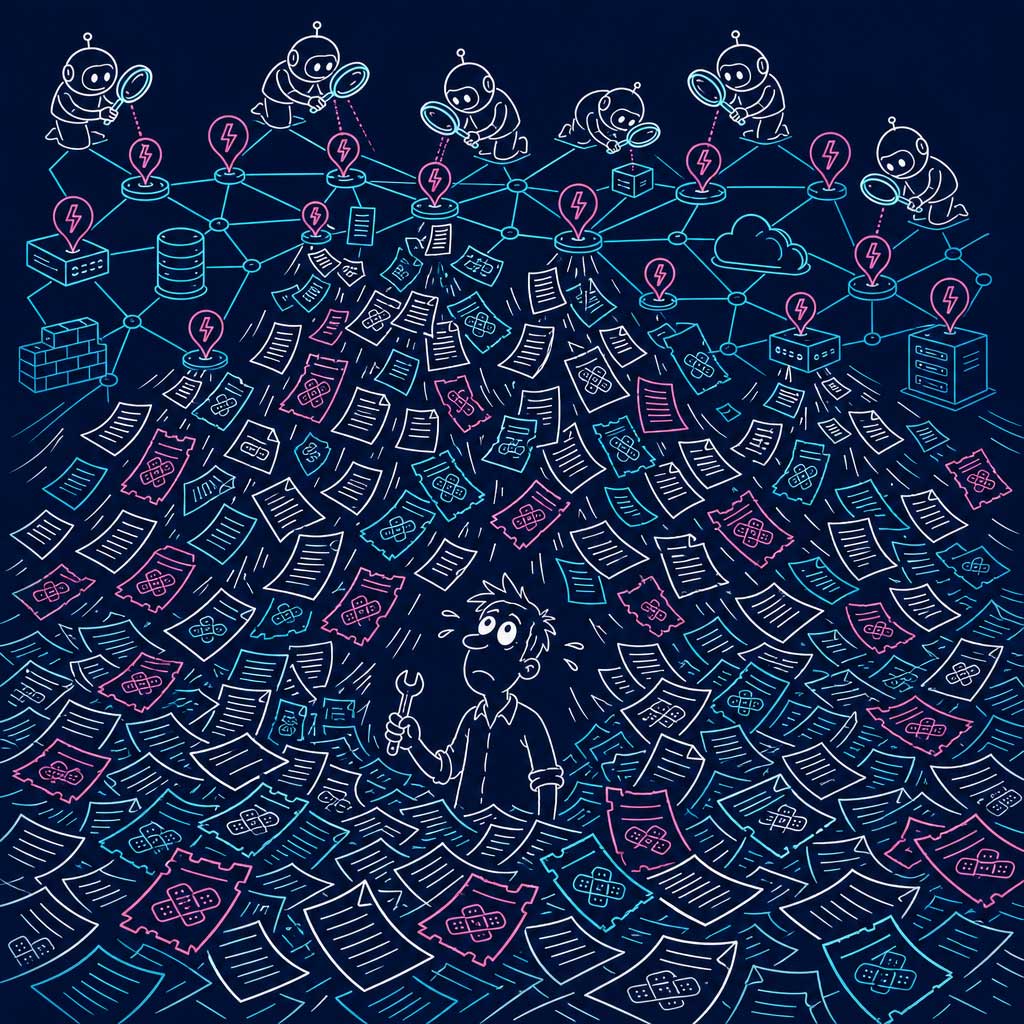
As highlighted by Mythos and follow-on models, AI is fundamentally changing both vulnerability discovery and exploitation. Researchers are finding more vulnerabilities, faster than ever before. Attackers are using AI to analyze them, develop exploits, and automate attacks at machine speed. Vendors are responding with a growing stream of security patches that enterprises ignore at their own peril.
The result is a patch avalanche.
The challenge is not whether organizations know they need to patch. They do. The challenge is that patching enterprise networks remains one of the most difficult operational tasks in IT.
Large enterprises commonly operate hundreds or thousands of devices across dozens of hardware platforms, operating systems, software versions, and configuration standards. Many networks have evolved over decades through mergers, acquisitions, and independent operational teams. Documentation is incomplete. Configuration drift is everywhere. Nobody wants to be responsible for the network outage caused by an upgrade gone wrong.
At the same time, the cost of delaying security remediation has never been higher.
The direct financial impact of a successful breach is measured in millions of dollars. Beyond incident response and recovery costs come lost productivity, customer disruption, regulatory investigations, contractual exposure, and increasingly heavy compliance penalties. Brand damage can linger for years after the technical problem has been resolved. Boards are asking harder questions. Regulators are asking harder questions. Customers are asking harder questions.
The conversation, but more importantly the economics, have shifted.
Network automation is no longer a productivity initiative that can wait until next year’s roadmap. It has become a critical cybersecurity capability.
Unfortunately, traditional approaches were never designed for today’s reality.
Most automation platforms assume the network is already clean, standardized, and modeled. Real enterprise networks rarely look like that. Before you can automate patch deployment, you first have to understand what devices actually exist, what software they are running, how they are configured, what dependencies exist, and whether a change can be executed safely across thousands of unique systems.
That brownfield onboarding problem has always been one of the biggest obstacles to enterprise network automation.
This is a problem Gluware is uniquely designed to solve.
Gluware was built specifically for existing multi vendor enterprise networks, not idealized greenfield environments. Our DIAL abstraction normalizes configuration state across dozens of network operating systems into a common operational model. That allows the platform to discover devices, create a working intent model from the existing network, validate current state, identify drift, determine which devices require remediation, and build validated workflows that safely execute changes at enterprise scale.
This is essential for real world brownfield network patching.
Instead of treating every device as a manual project, organizations can identify where vulnerable software exists, validate operational readiness, automate deployment, confirm successful execution, and continuously verify that intended state has actually been achieved. As the volume of security updates continues to accelerate, that capability is becoming a necessity rather than a nicety.
AI is changing cybersecurity faster than most organizations expected. The number of network vulnerabilities will continue to rise. The time between vulnerability disclosure and active exploitation is already shrinking dramatically and will continue to compress. Security teams will continue to demand faster remediation from network operations.
The organizations that succeed will not be the ones that hire enough engineers to keep up manually. They will be the ones that build automation capable of responding at machine speed while maintaining the predictability, governance, and validation required for production networks.
The network patch apocalypse is arriving whether you’re ready or not.
The question is whether your network operations team will be out ahead of it, or buried underneath it.
If your organization is facing growing patch backlogs, increasing compliance pressure, or accelerating security remediation requirements, schedule a Gluware demonstration. It’s now clear that the best time to build enterprise network automation was years ago. The second best time is now, before the next wave of critical vulnerabilities arrives.