By Alex Henthorn-Iwane, Senior Vice President of Marketing, Gluware
If you have ever seen a network organization with an SD-WAN controller running one part of the network, an intent platform in another, Ansible playbooks for a few workflows, and a great deal of CLI and ad-hoc scripting in between, you are not looking at an anomalous automation situation.
You are looking at the mainstream enterprise network.
The uncomfortable reality is that network automation rarely fails because engineers lack tools. It often fails because organizations struggle to unify an increasingly fragmented landscape of management domains, controllers, and operational models into a coherent representation of intent.
Enterprise Management Associates (EMA) has documented this challenge extensively. In its 2024 research of 354 IT professionals, EMA found that only 18% of organizations consider their network automation strategy a complete success, while 55% report only partial success. Nearly 94% use a mix of vendor and do-it-yourself solutions. EMA concluded that organizations routinely “cobble together a mix of homegrown, open source, and commercial tools” because “there isn’t one tool that can solve the entire problem.”
Gartner also weighs in here. According to their latest market guide on network automation platforms, 65% of enterprise networking activities remain manual.
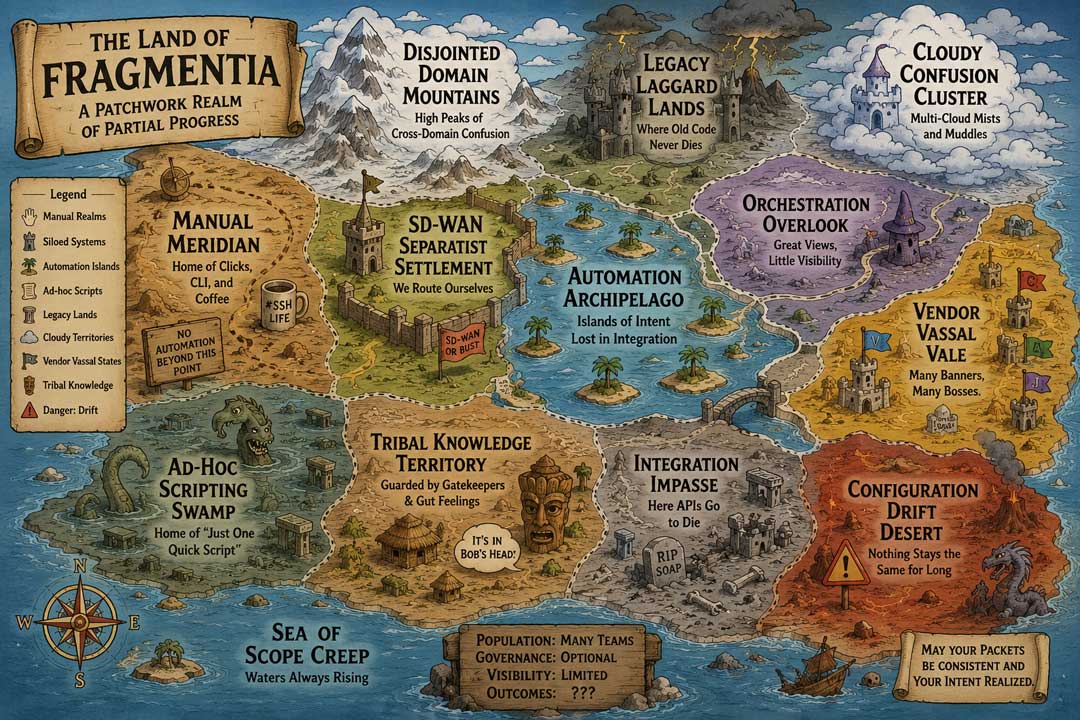
This creates what might be called the “Kingdom of Fragmentia,” a landscape of automation islands separated by oceans of manual operations.
The technical obstacles reported by EMA are revealing. Integration issues rank among the top challenges, alongside lack of standards and legacy infrastructure with inconsistent APIs and features. These are not merely tooling problems. They are data and intent problems.
The difficulty is that enterprise networks do not have a single control plane. They have many.
The campus may be managed one way. The WAN another. Cloud networking through hyperscaler constructs. Firewalls through their own management systems. IPAM, DCIM, identity, observability, and security each introduce additional domains of control. Every controller brings its own data model, abstractions, and operational assumptions.
Capturing all of these into a comprehensive intent model is extraordinarily difficult.
EMA Vice President Shamus McGillicuddy has observed that organizations increasingly have “a data problem” because “the data that represents their intent for a network is scattered across multiple spreadsheets, diagrams, wikis, and databases.”
This observation strikes at the heart of automation maturity. Automation is not fundamentally about pushing configurations. It is about expressing desired outcomes and ensuring systems converge toward them.
That is why the Network Source of Truth (NSoT) has become so important. EMA defines an NSoT as a repository that represents an organization’s intent for how its network should operate and behave. Automation tools reference that intent to ensure outcomes align with design.
But even here, the challenge remains. As industry practitioners have noted, a Source of Truth is often better understood as a Source of Intent because it captures how the network should look, not necessarily how it currently does. In fact, the Network Automation Forum’s NAF framework defines this aspect of automation as “intent” for this reason.
The hard part is not building automation. The hard part is capturing, modeling, and maintaining reality. The full reality, in all its messiness.
As networks span SD-WAN, cloud, security, data center, and edge domains, creating a unified intent model becomes increasingly complex. Automation islands emerge because organizations automate what they can reach and understand first. The result is partial automation, fragmented governance, and operational silos disguised as progress.
This challenge is exacerbated by the fact that most enterprise networks are patchwork quilts of vendors, devices, operating systems, software versions, and generations of architecture accumulated over decades.
Getting to a unified intent model in those environments is exceedingly difficult.
Network automation success ultimately depends less on writing playbooks and more on reconciling disparate domains into a coherent system of intent. Until organizations solve that problem, many will continue to inhabit Fragmentia: a land of controllers, scripts, and islands of automation separated by vast swathes of manual operations.
At Gluware, this is precisely the problem we set out to solve.
Real-world enterprise networks are messy. They rarely begin with clean architectures, standardized data models, or modern APIs. They are living systems built over years or decades through acquisitions, technology refreshes, vendor changes, and evolving business requirements.
Our DIAL technology was built for that reality.
Developed over more than 300 releases and more than one million engineering hours, DIAL can discover existing networks as they operate today and create a unified intent model grounded in operational reality. From there, organizations can standardize configurations, remediate drift, improve compliance, and automate consistently across domains over time.
If your organization finds itself inhabiting a kingdom, dukedom, earldom, or perhaps a lowly fiefdom of Fragmentia, we invite you to see what Gluware can do.
Request a demo and begin the journey from fragmented automation to governed intent.