
Why GluAPI?
Extend
Build new workflows on top of a proven automation foundation.
Integrate
Seamlessly integrate Gluware with third-party IT and DevOps platforms.
Automate
Enable automation across hybrid, multi-vendor environments.
See the top 5 reasons why industry leaders
automate their networks…
…followed by 20 reasons
why they choose Gluware.
Bring the full power of Gluware Intelligent Network Automation into your platforms with a RESTful API designed for integration, extensibility, and scale.
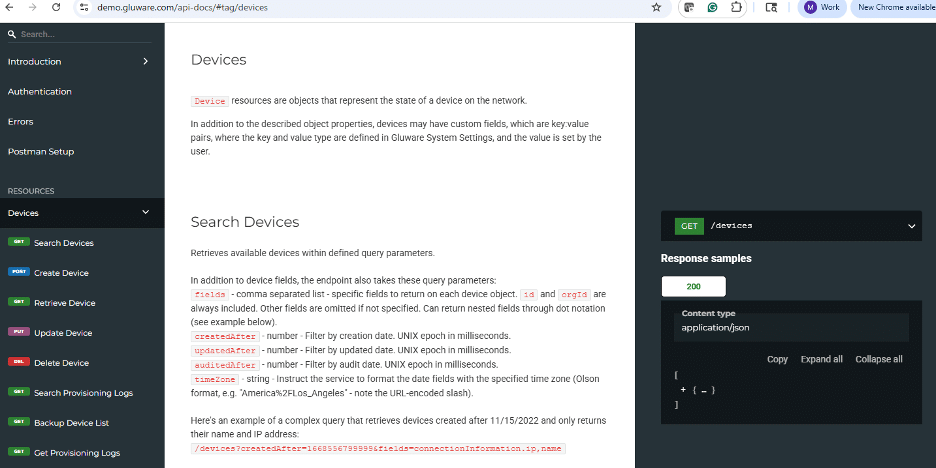
Built-In Documentation to Easily Programmatically Integrate with Gluware
Key Capabilities
With GluAPI, developers and IT teams can:
- Access Gluware device and organization data programmatically
- Leverage core endpoint services to interact with Gluware applications, including:
- Device Manager
- Config Drift & Audit
- Change Management
- Lifecycle Deployment
- Integrate Gluware automation into existing IT and DevOps ecosystems via API
Feature Highlights
Network automation doesn’t live in isolation. Enterprises rely on ecosystems of products—monitoring tools, configuration managers, IT workflows, and orchestration systems—that must work seamlessly together.
GluAPI is Gluware’s published RESTful API, giving you programmatic access to the entire Gluware Intelligent Network Automation Suite. With GluAPI, customers can extend Gluware’s capabilities directly into their workflows and applications—enabling advanced automation, orchestration, and data access wherever it’s needed.
Built for NetDevOps
GluAPI is designed with modern development principles in mind:
- RESTful Architecture — Predictable, resource-oriented URLs
- JSON Data Model — Consistent responses, including errors
- Standard HTTP Features — Authentication, verbs, response codes, caching
- Cross-Origin Resource Sharing (CORS) — Secure client-side integrations
- Common Authorization — Shared with Gluware Control UI for simplicity
Example Use Cases
- Inventory Management — Retrieve device and org data on demand
- Config Drift & Audit — Retrieve device and org data on demand
- Change Management — Streamline approvals and enforce policies
- Configuration Deployment — Push changes programmatically, at scale